logo
Products
PRODUCTS DETAILS
Home > Products >
High Temperature Muffle Furnace Silicon Molybdenum Rods for Fire Assay Gold Testing

High Temperature Muffle Furnace Silicon Molybdenum Rods for Fire Assay Gold Testing

MOQ: 1 Set
Price: Negotiate
Standard Packaging: Export wooden case with shock blocking for heating rods and refractory chamber
Delivery Period: 20-30 working days after deposit
Payment Method: T/T,L/C
Supply Capacity: Sufficient Supply Capacity
Detail Information
Place of Origin
Beijing, China
Brand Name
Y&X
Certification
ISO 9001
Model Number
Muffle Furnace
Rated Temperature:
1500℃
Heating Elements:
Silicon Molybdenum (MoSi2) Rods, 8 Pieces, Symmetric Layout
Voltage:
460V Three Phase
Temperature Sensor:
S-type Platinum-rhodium Thermocouple
Chamber Material:
Independent Cordierite-mullite Chamber Block
Door Type:
Pneumatic Vertical Lift Door, Foot Pedal Control
Applications:
Fire Assay Flux Fusion, Cupellation, Scorification, Ore Roast Preparation And High Temperature Heat Treatment
OEM/ODM:
Available
Rated Input Power:
25 KW (heating Power 19 KW)
Transformer:
Step-down Transformer Feeding The Silicon Molybdenum Heating Elements
Highlight:

Muffle Furnace Silicon Molybdenum Rods

,

High Temperature Muffle Furnace Fire Assay

,

Fire Assay Gold Testing Furnace

Product Description
1500℃ High Temperature Muffle Furnace with 82 L Chamber for Fire Assay

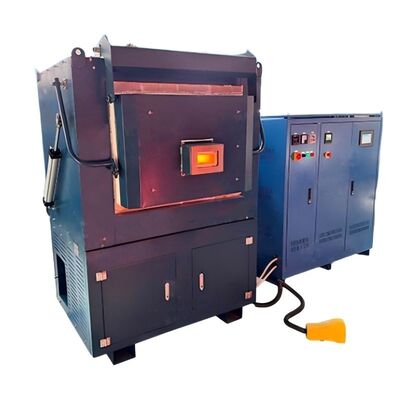
This 1500℃ muffle furnace is the heating core of a fire assay laboratory. Fire assay runs on three high temperature steps — flux fusion at 1000–1200℃, cupellation at 900–950℃ and scorification — and every one of them depends on the same three things: the furnace can hold the set point, the whole crucible batch sits in an even thermal field, and the chamber atmosphere stays clean and oxidising. The unit delivers 1500℃ from eight silicon molybdenum heating rods arranged symmetrically around the chamber, holds ±5℃ with an S-type platinum-rhodium thermocouple, and gives you an 82 L working chamber with a pneumatic vertical lift door.

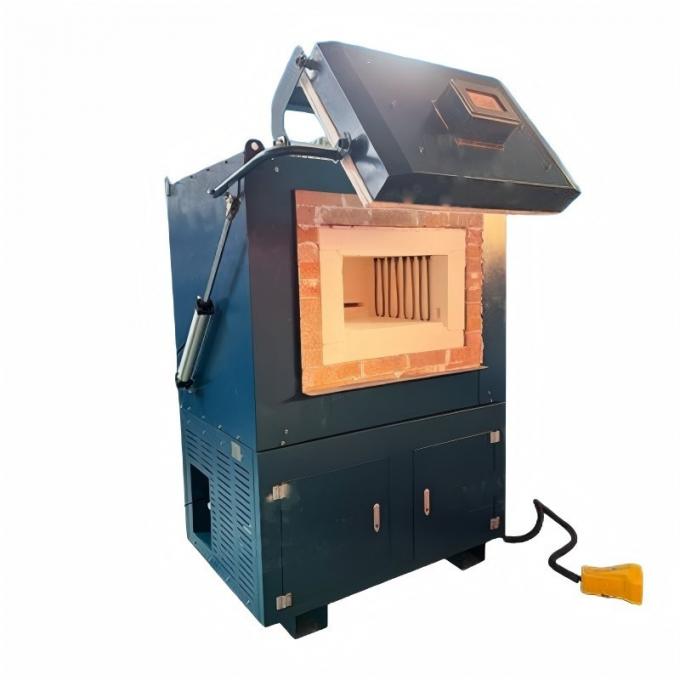
1500℃ high temperature muffle furnace with 82 L chamber and pneumatic vertical lift door for fire assay gold testing
Three Reasons Fire Assay Labs Choose This Unit
  • 1500℃ from eight molybdenum disilicide rods: MoSi₂ elements keep their output at temperature and do not oxidise or sag the way resistance wire does, so the furnace can sit at 1150℃ fusion temperature all day without losing set point accuracy. The eight rods are placed symmetrically around the chamber so the radiated heat is even on all four sides, not just at the back wall.
  • 82 L chamber, about five times the common 16 L lab furnace: the working chamber measures 295 x 485 x 575 mm. Twenty gold ore samples that would take a 16 L furnace several batches are fused in a single load, which cuts cycle time, energy cost and crucible handling risk at the same time.
  • Pneumatic vertical lift door with foot pedal: the door rises vertically on an air cylinder and is operated by a foot switch, so both hands stay free for the crucible tongs or the loading cart and the operator's arms never reach across the furnace mouth. Vertical travel also keeps the door seal even, which is why the unit holds temperature better than a swing door after repeated opening.
What Fire Assay Actually Requires
Requirement Why It Matters
Temperature range Flux fusion needs 1000–1200℃, cupellation needs 900–950℃, so the furnace has to sit above both with margin.
Temperature accuracy Fluctuation in the fusion hold directly changes precious metal recovery and lead button weight.
Chamber uniformity Crucibles across the batch must see the same heat or lead buttons come out inconsistent.
Atmosphere control Clean oxidising atmosphere, otherwise metal oxidation interferes with the assay result.
Technical Specifications
Rated Temperature 1500℃
Heating Elements Silicon molybdenum (MoSi₂) rods, 8 pieces, symmetric layout around the chamber
Rated Input Power 25 kW
Rated Heating Power 19 kW
Voltage 460V three phase
Temperature Sensor S-type platinum-rhodium thermocouple
Temperature Accuracy ±5℃
Chamber Material Independent cordierite-mullite chamber block
Chamber Working Dimensions (H x W x D) 295 x 485 x 575 mm
Chamber Volume Approx. 82 L
Overall Dimensions (L x W x H) 1440 x 1540 x 1810 mm
Door Type Pneumatic vertical lift door, foot pedal control
Typical Fusion Temperature 1000–1200℃
Typical Cupellation Temperature 900–950℃
Typical Applications
  • Fire assay flux fusion of gold, silver and PGM ore samples with litharge flux
  • Cupellation of lead buttons on bone ash or magnesia cupels
  • Scorification and annealing steps in precious metal assays
  • Sulphide and refractory ore roast preparation before fusion
  • High temperature ash determination, sintering and heat treatment work in the same laboratory
Why a Fire Assay Furnace Is Not a General Lab Furnace
  • Batch size decides throughput: an 82 L chamber changes the assay lab from batch-limited to shift-limited, which is usually the real bottleneck once the balance and cupellation stage are running smoothly.
  • Independent cordierite-mullite chamber: the chamber is a separate refractory block rather than a lining cast into the frame, so flux spillage or thermal cracking is repaired by replacing the block instead of scrapping the furnace.
  • Door design decides operator safety: foot-pedal vertical lift keeps the operator's face and arms away from the 1500℃ opening on every single load, hundreds of times a month.
  • 25 kW input, 19 kW heating power at 460V three phase: sized to bring an 82 L chamber to fusion temperature without a long ramp, and the 460V three phase supply matches North American laboratory power.
  • ISO 9001 production with OEM and ODM support: spare heating rods, thermocouples and door seals are supplied as separate service parts.
Control Panel and Electrical Components
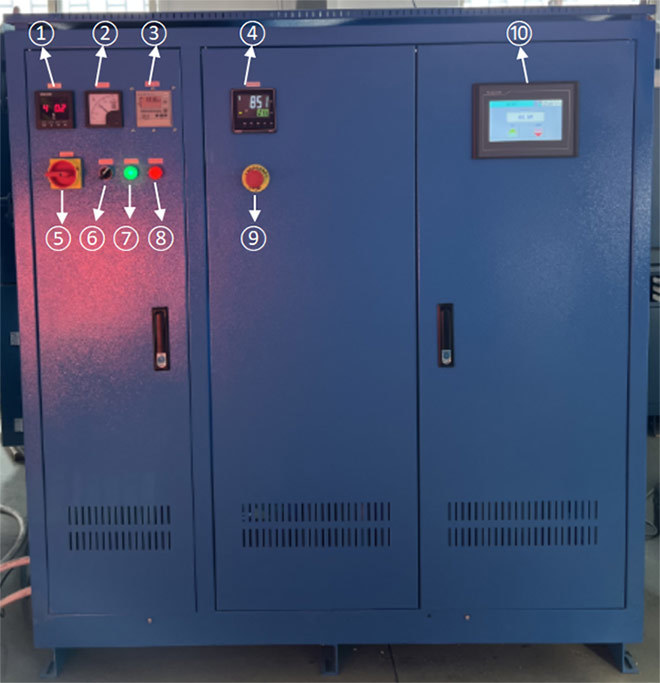
Control panel of the 1500℃ fire assay muffle furnace showing voltmeter, ammeter, timer, PID temperature controller, touchscreen and transformer
1 Voltmeter — reads the supply voltage at the panel
2 Ammeter — reads the load current drawn by the heating circuit, so a failing rod is spotted before it breaks
3 Timer — sets and displays the heating and holding period
4 Temperature controller — PID controller reading the S-type thermocouple and driving the heating output
5 Power switch — main supply isolation for the whole furnace
6 Heating switch — switches the heating circuit on and off independently of the main power
7 Power indicator lamp — confirms the panel is energised
8 Heating indicator lamp — shows that the heating output is active
9 Emergency stop button — cuts the heating circuit immediately in an emergency
10 Touchscreen — sets the temperature program, timer and alarm points, and displays the running curve
11 Transformer — step-down transformer between the 460V three phase supply and the silicon molybdenum heating elements, delivering the low voltage and high current the rods need
Size the Furnace to Your Assay Workload

Send three details and we reply with the chamber layout, the fusion program settings and a quotation instead of a generic price list:

  • Ore type and daily sample count — sulphide, oxide or refractory ore, and how many crucibles you run per shift
  • Crucible diameter and fusion program — we confirm how many crucibles the 295 x 485 x 575 mm chamber takes per load
  • Site voltage, phase and compressed air — 460V three phase is standard, 380V and 220V options are built to order, and the pneumatic door needs a compressed air line at your bench

Send an inquiry with these three points and our engineer will confirm the configuration before you commit to an order.

Frequently Asked Questions
Can the voltage be changed for my country? 460V three phase is the standard build. 380V/50Hz and 220V versions are built to order, with the transformer and heating element configuration matched to the supply, so the heating power stays the same.
How many crucibles fit in one load? The chamber working space is 295 x 485 x 575 mm. Crucible count depends on your crucible diameter and wall thickness, so send the size you use and we confirm the loading layout for your batch.
How long do silicon molybdenum rods last? Rod life depends on holding temperature, hours at temperature and chamber atmosphere. Spare rods, S-type thermocouples and door seals are quoted separately so a laboratory can keep one set in stock.
How fast does the furnace heat up? Heating power is 19 kW from a 25 kW input on the 82 L chamber, sized to reach fusion temperature without a long ramp. The ramp and hold curve is programmed on the touchscreen and agreed with you against your batch weight.
Does the pneumatic door need anything on site? Yes, a compressed air line to the bench. The door is driven by an air cylinder and operated by a foot switch, and the air line and regulator are specified in the installation drawing.
What is the lead time and how is it shipped? 20–30 working days after deposit, export wooden case with shock blocking for the heating rods and refractory chamber. Sea freight volume and gross weight are confirmed with the packing list.
Packing and Service
  • Export wooden case with shock blocking for the heating rods and refractory chamber
  • English operation manual, wiring diagram and thermocouple calibration certificate supplied
  • Spare MoSi₂ rods, S-type thermocouples, door seals and foot switches available separately
Products
PRODUCTS DETAILS
High Temperature Muffle Furnace Silicon Molybdenum Rods for Fire Assay Gold Testing
MOQ: 1 Set
Price: Negotiate
Standard Packaging: Export wooden case with shock blocking for heating rods and refractory chamber
Delivery Period: 20-30 working days after deposit
Payment Method: T/T,L/C
Supply Capacity: Sufficient Supply Capacity
Detail Information
Place of Origin
Beijing, China
Brand Name
Y&X
Certification
ISO 9001
Model Number
Muffle Furnace
Rated Temperature:
1500℃
Heating Elements:
Silicon Molybdenum (MoSi2) Rods, 8 Pieces, Symmetric Layout
Voltage:
460V Three Phase
Temperature Sensor:
S-type Platinum-rhodium Thermocouple
Chamber Material:
Independent Cordierite-mullite Chamber Block
Door Type:
Pneumatic Vertical Lift Door, Foot Pedal Control
Applications:
Fire Assay Flux Fusion, Cupellation, Scorification, Ore Roast Preparation And High Temperature Heat Treatment
OEM/ODM:
Available
Rated Input Power:
25 KW (heating Power 19 KW)
Transformer:
Step-down Transformer Feeding The Silicon Molybdenum Heating Elements
Minimum Order Quantity:
1 Set
Price:
Negotiate
Packaging Details:
Export wooden case with shock blocking for heating rods and refractory chamber
Delivery Time:
20-30 working days after deposit
Payment Terms:
T/T,L/C
Supply Ability:
Sufficient Supply Capacity
Highlight

Muffle Furnace Silicon Molybdenum Rods

,

High Temperature Muffle Furnace Fire Assay

,

Fire Assay Gold Testing Furnace

Product Description
1500℃ High Temperature Muffle Furnace with 82 L Chamber for Fire Assay

This 1500℃ muffle furnace is the heating core of a fire assay laboratory. Fire assay runs on three high temperature steps — flux fusion at 1000–1200℃, cupellation at 900–950℃ and scorification — and every one of them depends on the same three things: the furnace can hold the set point, the whole crucible batch sits in an even thermal field, and the chamber atmosphere stays clean and oxidising. The unit delivers 1500℃ from eight silicon molybdenum heating rods arranged symmetrically around the chamber, holds ±5℃ with an S-type platinum-rhodium thermocouple, and gives you an 82 L working chamber with a pneumatic vertical lift door.

1500℃ high temperature muffle furnace with 82 L chamber and pneumatic vertical lift door for fire assay gold testing
Three Reasons Fire Assay Labs Choose This Unit
  • 1500℃ from eight molybdenum disilicide rods: MoSi₂ elements keep their output at temperature and do not oxidise or sag the way resistance wire does, so the furnace can sit at 1150℃ fusion temperature all day without losing set point accuracy. The eight rods are placed symmetrically around the chamber so the radiated heat is even on all four sides, not just at the back wall.
  • 82 L chamber, about five times the common 16 L lab furnace: the working chamber measures 295 x 485 x 575 mm. Twenty gold ore samples that would take a 16 L furnace several batches are fused in a single load, which cuts cycle time, energy cost and crucible handling risk at the same time.
  • Pneumatic vertical lift door with foot pedal: the door rises vertically on an air cylinder and is operated by a foot switch, so both hands stay free for the crucible tongs or the loading cart and the operator's arms never reach across the furnace mouth. Vertical travel also keeps the door seal even, which is why the unit holds temperature better than a swing door after repeated opening.
What Fire Assay Actually Requires
Requirement Why It Matters
Temperature range Flux fusion needs 1000–1200℃, cupellation needs 900–950℃, so the furnace has to sit above both with margin.
Temperature accuracy Fluctuation in the fusion hold directly changes precious metal recovery and lead button weight.
Chamber uniformity Crucibles across the batch must see the same heat or lead buttons come out inconsistent.
Atmosphere control Clean oxidising atmosphere, otherwise metal oxidation interferes with the assay result.
Technical Specifications
Rated Temperature 1500℃
Heating Elements Silicon molybdenum (MoSi₂) rods, 8 pieces, symmetric layout around the chamber
Rated Input Power 25 kW
Rated Heating Power 19 kW
Voltage 460V three phase
Temperature Sensor S-type platinum-rhodium thermocouple
Temperature Accuracy ±5℃
Chamber Material Independent cordierite-mullite chamber block
Chamber Working Dimensions (H x W x D) 295 x 485 x 575 mm
Chamber Volume Approx. 82 L
Overall Dimensions (L x W x H) 1440 x 1540 x 1810 mm
Door Type Pneumatic vertical lift door, foot pedal control
Typical Fusion Temperature 1000–1200℃
Typical Cupellation Temperature 900–950℃
Typical Applications
  • Fire assay flux fusion of gold, silver and PGM ore samples with litharge flux
  • Cupellation of lead buttons on bone ash or magnesia cupels
  • Scorification and annealing steps in precious metal assays
  • Sulphide and refractory ore roast preparation before fusion
  • High temperature ash determination, sintering and heat treatment work in the same laboratory
Why a Fire Assay Furnace Is Not a General Lab Furnace
  • Batch size decides throughput: an 82 L chamber changes the assay lab from batch-limited to shift-limited, which is usually the real bottleneck once the balance and cupellation stage are running smoothly.
  • Independent cordierite-mullite chamber: the chamber is a separate refractory block rather than a lining cast into the frame, so flux spillage or thermal cracking is repaired by replacing the block instead of scrapping the furnace.
  • Door design decides operator safety: foot-pedal vertical lift keeps the operator's face and arms away from the 1500℃ opening on every single load, hundreds of times a month.
  • 25 kW input, 19 kW heating power at 460V three phase: sized to bring an 82 L chamber to fusion temperature without a long ramp, and the 460V three phase supply matches North American laboratory power.
  • ISO 9001 production with OEM and ODM support: spare heating rods, thermocouples and door seals are supplied as separate service parts.
Control Panel and Electrical Components
Control panel of the 1500℃ fire assay muffle furnace showing voltmeter, ammeter, timer, PID temperature controller, touchscreen and transformer
1 Voltmeter — reads the supply voltage at the panel
2 Ammeter — reads the load current drawn by the heating circuit, so a failing rod is spotted before it breaks
3 Timer — sets and displays the heating and holding period
4 Temperature controller — PID controller reading the S-type thermocouple and driving the heating output
5 Power switch — main supply isolation for the whole furnace
6 Heating switch — switches the heating circuit on and off independently of the main power
7 Power indicator lamp — confirms the panel is energised
8 Heating indicator lamp — shows that the heating output is active
9 Emergency stop button — cuts the heating circuit immediately in an emergency
10 Touchscreen — sets the temperature program, timer and alarm points, and displays the running curve
11 Transformer — step-down transformer between the 460V three phase supply and the silicon molybdenum heating elements, delivering the low voltage and high current the rods need
Size the Furnace to Your Assay Workload

Send three details and we reply with the chamber layout, the fusion program settings and a quotation instead of a generic price list:

  • Ore type and daily sample count — sulphide, oxide or refractory ore, and how many crucibles you run per shift
  • Crucible diameter and fusion program — we confirm how many crucibles the 295 x 485 x 575 mm chamber takes per load
  • Site voltage, phase and compressed air — 460V three phase is standard, 380V and 220V options are built to order, and the pneumatic door needs a compressed air line at your bench

Send an inquiry with these three points and our engineer will confirm the configuration before you commit to an order.

Frequently Asked Questions
Can the voltage be changed for my country? 460V three phase is the standard build. 380V/50Hz and 220V versions are built to order, with the transformer and heating element configuration matched to the supply, so the heating power stays the same.
How many crucibles fit in one load? The chamber working space is 295 x 485 x 575 mm. Crucible count depends on your crucible diameter and wall thickness, so send the size you use and we confirm the loading layout for your batch.
How long do silicon molybdenum rods last? Rod life depends on holding temperature, hours at temperature and chamber atmosphere. Spare rods, S-type thermocouples and door seals are quoted separately so a laboratory can keep one set in stock.
How fast does the furnace heat up? Heating power is 19 kW from a 25 kW input on the 82 L chamber, sized to reach fusion temperature without a long ramp. The ramp and hold curve is programmed on the touchscreen and agreed with you against your batch weight.
Does the pneumatic door need anything on site? Yes, a compressed air line to the bench. The door is driven by an air cylinder and operated by a foot switch, and the air line and regulator are specified in the installation drawing.
What is the lead time and how is it shipped? 20–30 working days after deposit, export wooden case with shock blocking for the heating rods and refractory chamber. Sea freight volume and gross weight are confirmed with the packing list.
Packing and Service
  • Export wooden case with shock blocking for the heating rods and refractory chamber
  • English operation manual, wiring diagram and thermocouple calibration certificate supplied
  • Spare MoSi₂ rods, S-type thermocouples, door seals and foot switches available separately